Understanding the Manifold Hypothesis: Why High-Dimensional Data Isn’t As Random As You Think
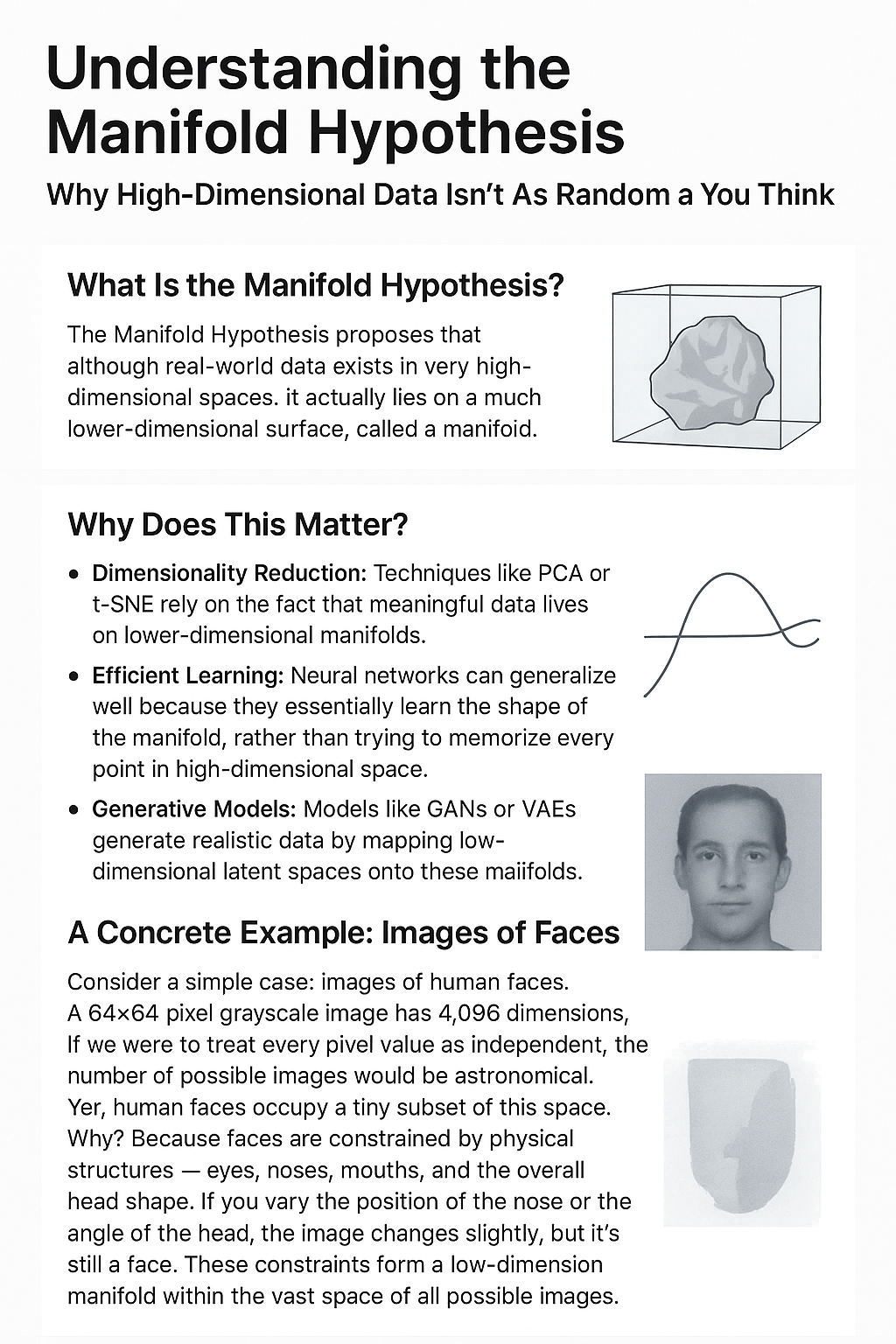
In the world of machine learning and deep learning, we often deal with data that seems overwhelmingly complex. Images with millions of pixels, audio clips with thousands of sample points, or high-dimensional sensor data can feel like a chaotic mess. Yet, behind this complexity, there’s a fascinating idea known as the Manifold Hypothesis — a guiding principle that helps explain why machine learning models can learn from such “high-dimensional” data at all.
What Is the Manifold Hypothesis?
At its core, the Manifold Hypothesis proposes that although real-world data exists in very high-dimensional spaces, it actually lies on a much lower-dimensional surface, called a manifold.
Think of it like this: a sheet of paper is two-dimensional. Now crumple it and place it inside a three-dimensional box. Even though it exists in 3D space, the paper itself is still fundamentally 2D. Similarly, complex data may live in a space of thousands or even millions of dimensions, but the “interesting” variations of that data actually occupy a much smaller, structured subset of that space.
Why Does This Matter?
Machine learning thrives on structure. If data were completely random in high-dimensional space, learning patterns would be nearly impossible. The Manifold Hypothesis gives us a reason why algorithms like deep neural networks, autoencoders, and generative models succeed:
Dimensionality Reduction: Techniques like PCA or t-SNE rely on the fact that meaningful data lives on lower-dimensional manifolds.
Efficient Learning: Neural networks can generalize well because they essentially learn the shape of the manifold, rather than trying to memorize every point in high-dimensional space.
Generative Models: Models like GANs or VAEs generate realistic data by mapping low-dimensional latent spaces onto these manifolds.
A Concrete Example: Images of Faces
Consider a simple case: images of human faces. A 64×64 pixel grayscale image has 4,096 dimensions. If we were to treat every pixel value as independent, the number of possible images would be astronomical. Yet, human faces occupy a tiny subset of this space.
Why? Because faces are constrained by physical structures — eyes, noses, mouths, and the overall head shape. If you vary the position of the nose or the angle of the head, the image changes slightly, but it’s still a face. These constraints form a low-dimensional manifold within the vast space of all possible images.
In other words, learning to generate or recognize faces is feasible because the data lies on a structured manifold.
Implications for Machine Learning
Understanding the Manifold Hypothesis has practical implications:
- Model Design: Neural networks should exploit the underlying structure of data, not just its dimensionality.
- Data Augmentation: Transformations like rotations or lighting changes can help models explore the manifold more thoroughly.
- Anomaly Detection: Points far from the manifold can be treated as anomalies or outliers.
Final Thoughts
The Manifold Hypothesis is a powerful mental model for thinking about high-dimensional data. It reminds us that even in the chaos of millions of pixels or thousands of sensor readings, there’s an underlying structure waiting to be discovered. By understanding and leveraging this structure, we can build more efficient, robust, and intelligent machine learning models.
*This post originally appeared on my Medium
.*
Enjoyed this article? You can also read and engage with it on Medium:
Read on Medium